Wondering where the baikal sable lives? You’ll find this small forest hunter across Siberia and into northern China. The sources here describe the whole species, not a Baikal-only population.
This page sits inside the wider guide to the sable animal, and it focuses on where the species lives.
| Item | Value |
|---|---|
| Head-body length (males) | 38-56 cm |
| Weight (males) | 800-1800 g |
| Home territory | 4 to 30 square kilometers |
| Gestation | 250-300 days |
| Weaning age | seven weeks |
| IUCN Red List status | Least Concern (2009 handbook) |
The figures come from the Handbook of the Mammals of the World entry and the One Earth species profile. Numbers like these can change as new surveys appear, so check the source before you rely on them.
Where does the baikal sable live?
Animal Diversity Web says Martes zibellina is found throughout northern Asia and once spanned the area from Scandinavia to northern China. Its current distribution does not reach as far west, but it is still found throughout Siberia into northern China.
None of the sources used here describes a separate Baikal population, so this page covers the species as a whole and makes no claims about Baikal itself.
The 2009 Handbook of the Mammals of the World entry lists these places in the sable’s distribution:
- China
- Japan (Hokkaido)
- Mongolia
- North Korea
- Russia
That entry also says thirty subspecies have been proposed and that a taxonomic revision is needed, so firm subspecies boundaries remain open (handbook entry).
Forest habitat across Siberia
Across northern Asia the sable lives in dense taiga forests, flatlands and mountain regions. In eastern Siberia that means spruce and cedar forests, while western Siberia has larch and pine forests. It seems to avoid only extremely barren high mountain tops, according to Animal Diversity Web.
The handbook entry adds that sables typically prefer mature forests of large trees with a dense canopy, and that they avoid open areas. In the Daxinganling Mountains of China, they prefer late succession mixed forests with large trees and coarse woody debris.

One Earth says dens are often hidden near riverbanks, and the handbook lists several kinds of den and rest site. They include:
- holes among or under rocks
- hollow logs
- spaces under tree roots
- burrows that may be several meters long and end in a nest chamber lined with dry vegetation and fur
See the One Earth profile for its description of the riverbank setting.
Size, coat and build
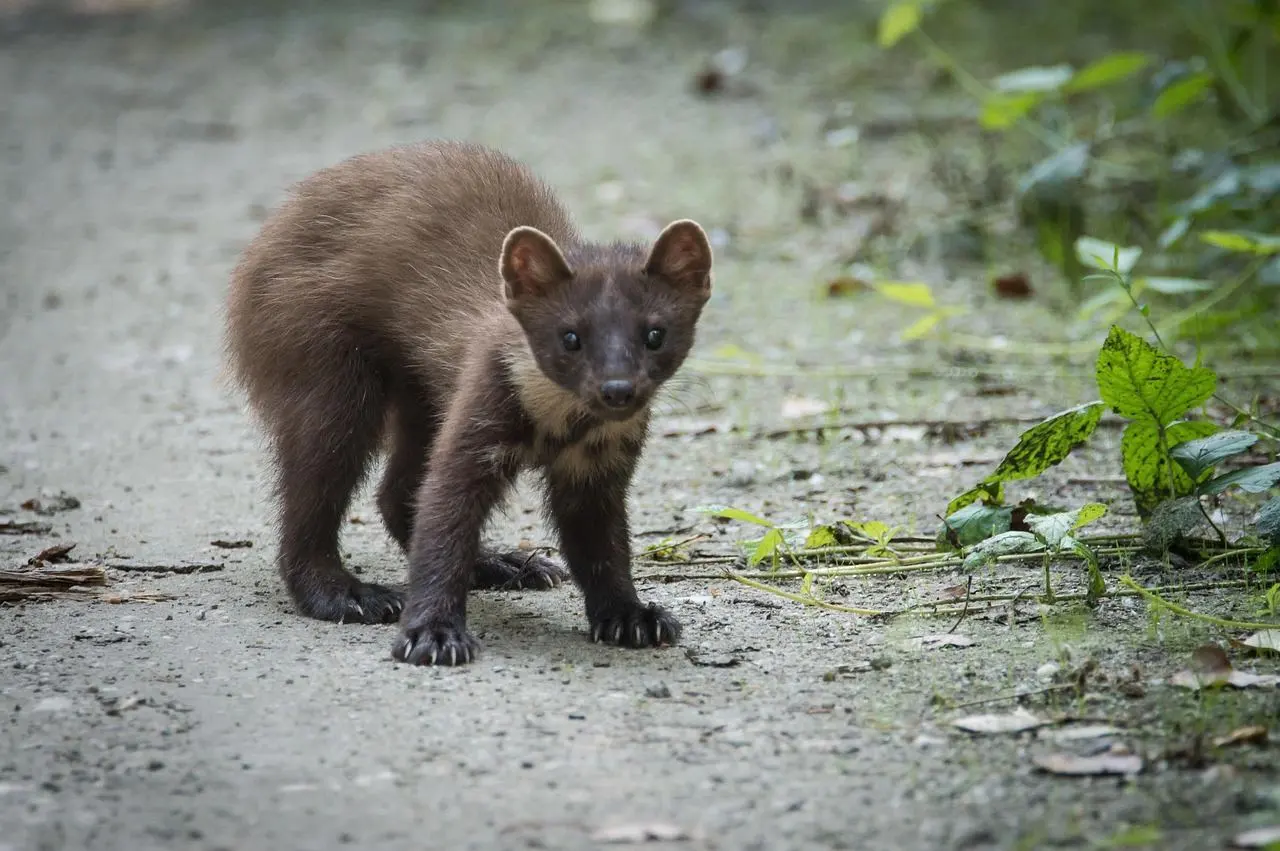
The handbook gives adult males a head-body length of 38-56 cm and a weight of 800-1800 g. Females are slightly smaller at 35-51 cm and 700-1560 g. Male tails run 12-19 cm.
The pelage is long and silky, varying from pale grayish-brown to dark brown, almost black. The summer coat is shorter and darker, while Animal Diversity Web notes the winter coat is longer and more luxurious.
Animal Diversity Web also describes a light throat patch that may be gray, white or pale yellow. The handbook, by contrast, calls the white neck patch vestigial, and says the soles are covered with extremely dense, stiff hairs.
Food, territory and daily rhythm
The handbook says the diet consists mostly of small mammals such as rodents, pikas and hares. It also includes birds, reptiles, amphibians, fish, insects, fruits, honey, nuts and berries.
Each sable defends a home territory of 4 to 30 square kilometers, according to One Earth, and food and local geography largely set its size. In winter, when food is scarce, sables expand their range and may travel up to 12 kilometers per day.
Animal Diversity Web calls the sable a major predator of small rodents in northern Asia and Siberia (source). Sources disagree on when it is active:
- Animal Diversity Web describes individuals as diurnal.
- The handbook says sables are active both during the day and at night, with radio-collared animals in the Daxinganling Mountains nocturnal in spring and winter and diurnal in summer and autumn.
- One Earth says they are primarily active at dawn and dusk and shift to daytime activity during the mating season.
The mix suggests that timing shifts with season and place, so treat any single label with caution (handbook).
Breeding and development
Mating occurs from June to August. Implantation of the fertilized eggs is delayed, and births occur the following spring, in April or May. Total gestation is 250-300 days, according to the handbook.
The handbook gives a litter size of one to five, usually three or four. Animal Diversity Web allows a wider range of one to seven, with two or three more common.
The handbook gives this development timeline for young sables:
- At birth the young weigh 30-35 g.
- Their eyes open after 30-36 days.
- They emerge from the den at 38 days.
- They are weaned after seven weeks.
- Sexual maturity is reached at 15-16 months.
Hunting, status and conservation
Sables are hunted for fur, and the 2009 handbook calls it one of the most valuable furs produced in Europe and Asia. As of that handbook, the species was classified as Least Concern on the IUCN Red List and considered common throughout most of its distribution.
The same entry says the sable was once common in China but is now considered rare. It adds that sables are raised on fur farms and that over 25,000 are harvested annually.
Animal Diversity Web says the species has been hunted for its fur throughout human history and that numbers were once severely reduced. Its account, which gives no date for this statement, says hunting is allowed only for licensed persons and that fur farms were set up to let wild populations grow (source).
Local assessments can differ from the global one. The Mongolian Red List of Mammals rated the sable Vulnerable in 2006 because its fur is highly valued and hunting has caused a decline in the Mongolian population.
For a wider look at how the species is rated, read the guide to sable conservation status. The story of why pelts mattered so much is told in the sable fur trade history guide.
Frequently asked questions
Is the baikal sable a separate species?
Show answer
None of the sources supplied here treats it as one. They describe a single species, Martes zibellina, and the handbook entry says its many proposed subspecies still need a taxonomic revision.
Can sables climb trees?
Show answer
Yes. The handbook describes sables as mainly terrestrial but also good tree climbers.
Do sables live in groups?
Show answer
No, they are solitary outside the breeding season, per the handbook. Males and females do share overlapping ground at times, but males rarely overlap with each other.
What do sables do in a snowstorm?
Show answer
They shelter in the den, sometimes for days, and may also hide there when people are hunting them. In extreme weather a sable stores prey in its den until it can hunt again, according to Animal Diversity Web.
How long do sables live?
Show answer
In the wild the probable maximum is 8 years, while animals on fur farms have been observed to reach 18 years (Animal Diversity Web).