Spotted a photo of a dark antelope with sweeping horns and wondered what it is? That’s a sable antelope, a large grazer of African wooded savanna. Here’s how to recognise one.
Start with our sable animal guide if you want the bigger picture; this page focuses on the antelope.
| Item | Value |
|---|---|
| Scientific name | Hippotragus niger |
| Typical male weight | 235 kg |
| Typical female weight | 220 kg |
| Male horn length | 81-165 centimeters |
| Gestation | 8 to 9 months |
| Lifespan in the wild | Up to 16 years |
The figures come from Wikipedia and Animal Diversity Web. They can change, so check the source before you rely on them.
What does a sable antelope look like?
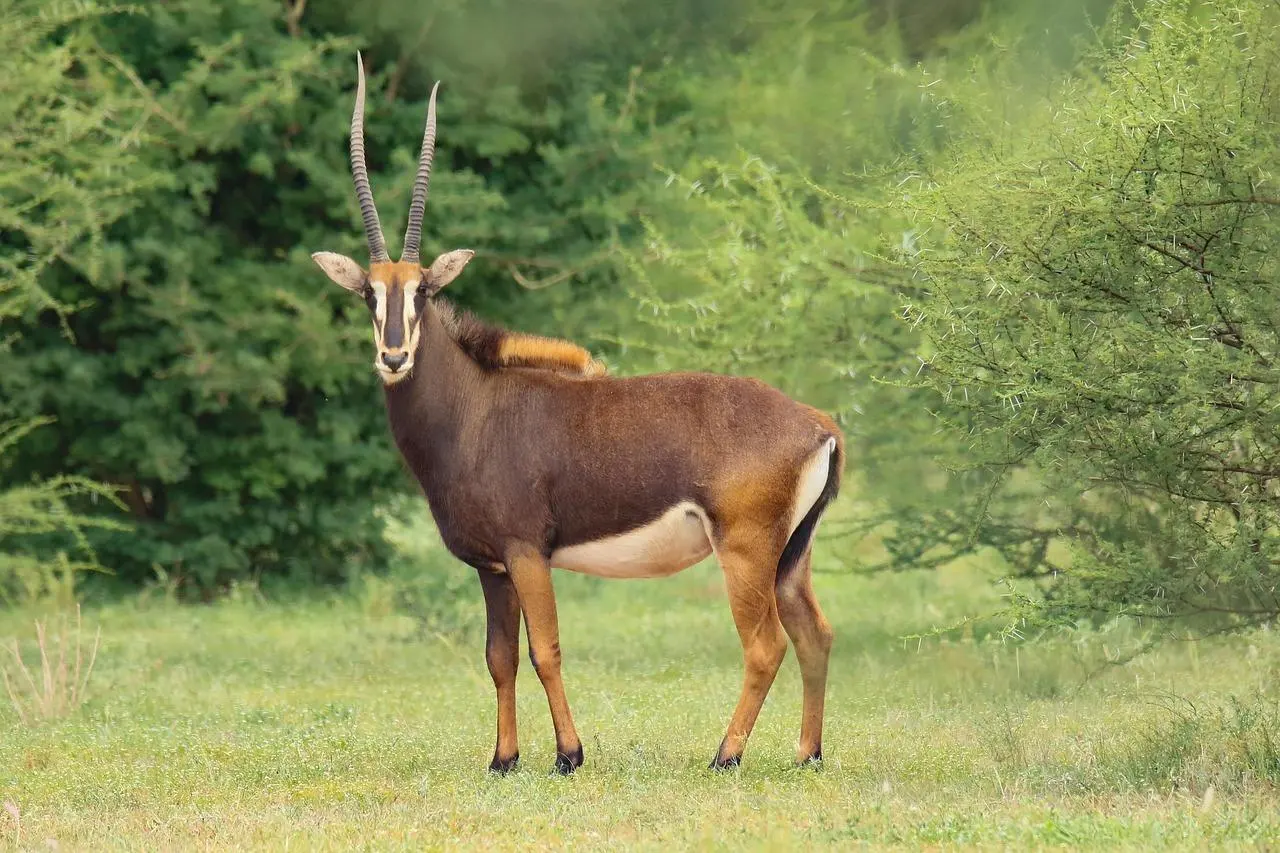
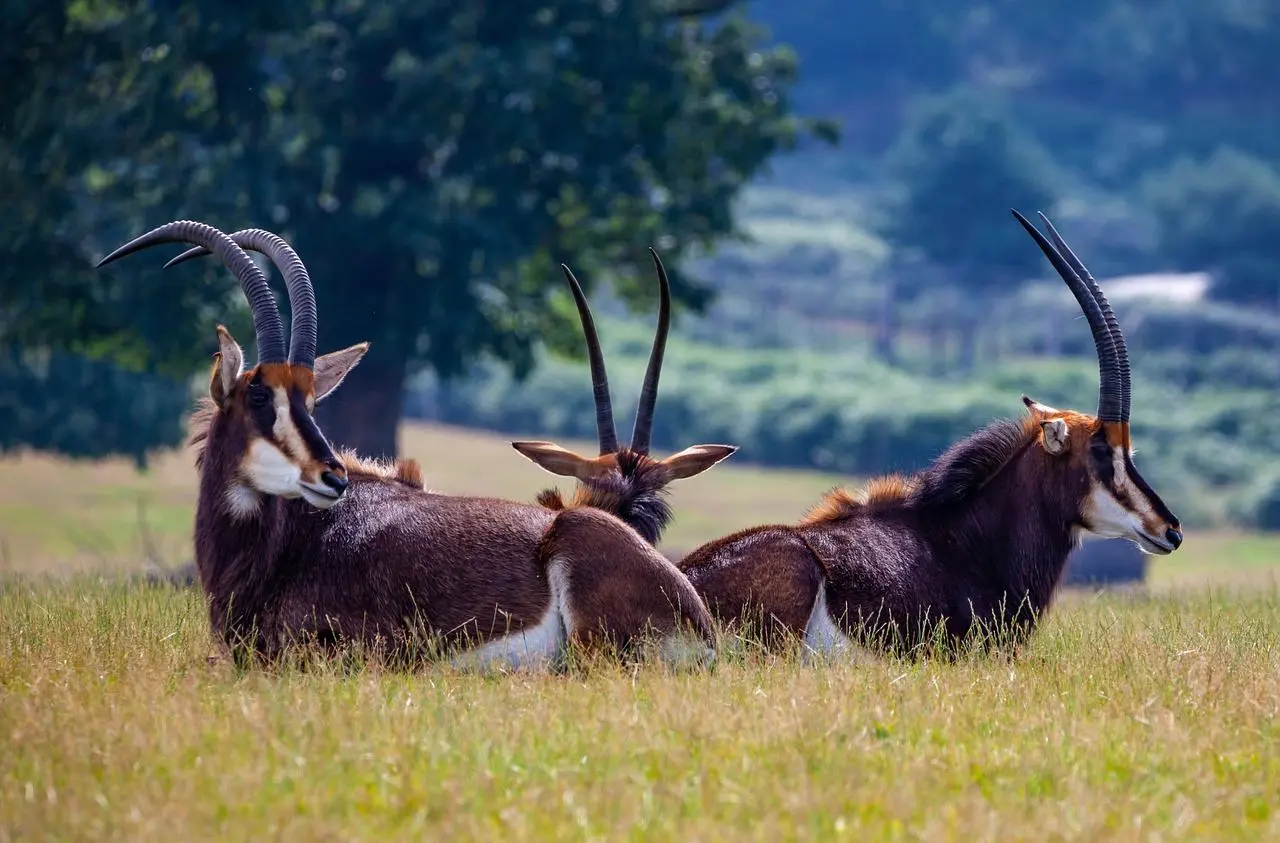
The sable antelope is sexually dimorphic: the male is heavier and about one-fifth taller than the female, according to Wikipedia. Males typically weigh 235 kg and females 220 kg. Males reach about 117-140 cm at the shoulder.
Colour changes with age and sex. Females and juveniles are chestnut to dark brown, while males begin darkening and turn black after three years, as Wikipedia describes it. Calves less than two months old are a light tan with faint markings.
Three features help you recognise one at a glance:
- Mane: a well-developed and often upright mane on the neck, plus a short mane on the throat (Wikipedia).
- Face and body markings: most animals have white “eyebrows”, cheek stripes, a white belly and a white rump patch (Animal Diversity Web).
- Horns: massive and curved in males, reaching 81-165 centimeters, while females’ horns are 61-102 centimeters (Animal Diversity Web).
If you landed here while researching the word sable in a fashion context, our sable fur trade history page covers that separate topic.
Where the sable antelope lives
The sable antelope inhabits wooded savanna in East and Southern Africa, from the south of Kenya to South Africa, with a separated population in Angola (Wikipedia).
Animal Diversity Web places it mainly in the Miombo Woodland Zone. Favorable habitat is a mixture of savanna woodlands and grassland, and the animal avoids extensive open lands if it can.
The Mammal Diversity Database lists these countries in its distribution record:
- East Africa: Kenya and Tanzania.
- Central and southern Africa: Angola, Botswana, the Democratic Republic of the Congo, Malawi, Mozambique, Namibia, Zambia and Zimbabwe.
- South Africa.
Feeding grounds shift with the seasons. In the dry season the animals use grassland areas that were once flooded, then burned, which produces new growth (Animal Diversity Web).
Animal Diversity Web names several places that are good for viewing sable antelope:
- Shimba Hills National Reserve, Kenya.
- Ruaha National Park, Tanzania.
- Kafue, Zambia.
- Hwange, Zimbabwe.
- Kruger National Park, South Africa.
Diet and daily habits
Sable antelope are specialised grazers that feed on foliage and herbs, especially those growing on termite mounds. In the dry season they are less reluctant to browse, according to Animal Diversity Web.
They are picky about grass height. Grasses make up as much as ninety percent of the diet, eaten at heights of 40-140 millimeters from the ground with only the leaf taken (Animal Diversity Web).
In a savannah setting they are the last to feed on the new grasses available in the late dry season, when food is vital. That narrow feeding pattern may be one reason numbers have declined, per the same page on Animal Diversity Web.
The animals are both nocturnal and diurnal. They prefer to feed just until dark because predation risk at night is high (Animal Diversity Web).
Herd life, breeding and lifespan
Herds consist of many females (15-25 members) and young, along with one dominant male (Animal Diversity Web).
That male defends a foraging territory extending 300 to 500 meters out from the herd. Males fight when a territory is challenged, but fights to the death are rare, says Animal Diversity Web.
A sable antelope’s year follows a seasonal calendar:
- Mating runs from May to July, with a peak in June (ADW).
- Gestation lasts 8 to 9 months, and normally one calf is born at the end of the rainy season, when long grass gives cover (ADW).
- Weaning comes six months after birth (ADW).
- Females start to breed at 2.5 years old. Males are evicted from female groups at 3 to 4 years, then live in bachelor herds until sexual maturity at 5 years (ADW).
In the wild a sable antelope can live up to 16 years, and over 19 years in captivity, according to Animal Diversity Web.
The four subspecies
Wikipedia describes four subspecies:
- Southern sable (H. n. niger): the nominate subspecies, first described and named in 1838. It tends to have the darkest coat and occurs south of the Zambezi River.
- Giant sable (H. n. variani): both sexes are larger with longer horns, and it is found only in a few remaining localities in central Angola.
- Zambian sable (H. n. kirkii): the largest geographic range of the four, reaching north of the Zambezi into southwestern Tanzania.
- Eastern sable (H. n. roosevelti): the smallest subspecies, centred on the Shimba Hills in southern Kenya.
Experts do not fully agree on the split. The Mammal Diversity Database notes that its species entry includes roosevelti, which another taxonomy considered distinct.
How many sable antelope are left?
Wikipedia’s species box shows Least Concern on the IUCN Red List, citing an assessment by the IUCN SSC Antelope Specialist Group dated 2017 (Wikipedia). The same page says the giant sable is classed as Critically Endangered and sits on Appendix I of CITES.
South Africa tells a tighter story. As of the Red List of South African Species assessment dated January 2016, the sable antelope is Vulnerable there, with the free-roaming population within its natural range estimated at 681 individuals (SANBI).
The largest subpopulation, in Kruger National Park, was estimated at 385 individuals. Long-term data show an overall decline by an estimated 65% over three generations, mainly from the drop in that park, says SANBI.
Private land adds a twist. SANBI estimates 6,995 individuals on private game farms and ranches, yet at least 63% of subpopulations in its private-land sample are kept in breeding camps or enclosures, so they do not count as wild (SANBI).
The same assessment says the species has been eliminated from large parts of its former range by:
- bushmeat hunting;
- habitat loss to agricultural expansion;
- habitat degradation, including bush encroachment;
- competition with other grazers, including livestock.
Its recommended interventions centre on correct habitat management, such as:
- de-stocking competing herbivores;
- reducing artificially high predator numbers;
- fire management.
For a wider look at how sable species are rated, see our sable conservation status guide.
Frequently asked questions
Is the sable antelope endangered?
Show answer
Not worldwide: the IUCN rating is Least Concern as of that 2017 assessment, per Wikipedia. South Africa’s regional listing from January 2016 is Vulnerable, according to SANBI, so the answer depends on where you look.
How long is a sable antelope?
Show answer
Head-and-body length typically falls between 190 and 255 cm, and the tuft-tipped tail adds a further 40-75 cm of its own, based on Wikipedia.
What other names does it go by?
Show answer
Swahili speakers say mbarapi, Afrikaans uses swartwitpens and Shona uses ngwarati. “Great sable antelope” or simply “sable” also appear in English, as Wikipedia lists.
Which animals are its closest relatives?
Show answer
It shares the genus Hippotragus with the roan antelope and the extinct bluebuck. A mitochondrial DNA analysis of a mounted bluebuck placed that species outside the group holding the roan and sable, per Wikipedia.